The British Columbia Assembly offers an invitation for the People to return to the land and soil jurisdiction to reclaim their sovereignty. Unbeknownst to most inhabitants of BC, they have been adrift at sea, in the legal jurisdiction of the water under Maritime and Admiralty law where rights and freedoms are severely constrained. However, it is now time for correcting this distortion and setting the record straight, and for reclaiming natural, creator-given rights. To assist with this endeavor is our Assembly's mission and its goal.
The Jural Pillar
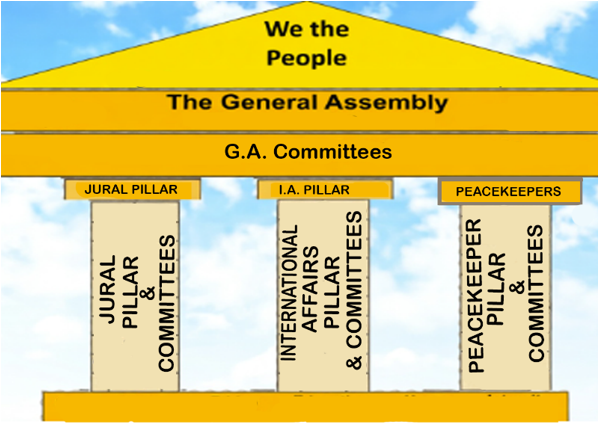
The State/Provincial Jural Assembly is one of three pillars that support
the State’s General Assembly. The Pillars are unique organizational units of the land and soil jurisdiction and are dedicated to their
individual State/Province.
It is the Jural Pillar which defines the physical boundaries of its land and creates its Counties. (Note that Jural Societies are the
organizational units of the sea and its corresponding maritime courts.) Living People, acting as ‘people’ (not persons) work together to make up their Jural Pillar.
The Public Law of the Land is enforced by the Jural Pillar together with the Peacekeeping (Militia) Pillar the land and soil jurisdiction courts, along with its courts’ officers. The Jural Pillar organizers are responsible for ensuring the eligibility of those who will serve as officers and as jurors.
The International Affairs (Business) Pillar
The International Affairs (Business) Pillar functions between States/Provinces to facilitate trade and business interactions between them. This Pillar is also one of the three pillars which reports their findings, suggestions, and recommendations to the General Assembly when joint projects between nation states are undertaken. Each General Assembly will have a Treasurer who becomes a member of the International Affairs (Business) Pillar.
The Peacekeepers (Militia) Pillar
This third pillar focuses on its local communities and prepares to
assist in times of disaster (flood, fire, earthquake, etc.). Additionally,
this pillar promotes and enforces the Public Law and provides training to the general public so that each community becomes skilled and trained in first-aid, rescue, etc. They also work with local law enforcement, as needed, to keep the peace.
The Jural Pillar is one of the three component pillars, as stated above, which complete and support the General Assembly.
Each State/Province will have a unique Jural Pillar that is dedicated to its individual State/Province. It is an ‘organizational unit’ of the land and soil jurisdiction court system. When the People ‘assemble’ they create a Jural Pillar. It is the Jural Pillar which creates the the Counties on the soil jurisdiction, and which also creates the States/Provinces on the Land. This becomes crucially important in a time when the existing de facto government seeks to ensure that you never become truly sovereign. This is done by keeping you ensnared in the Maritime jurisdiction of the Water (Sea).
[Note that ‘Jural Societies’ are also organizational units; however, they are units/entities of the sea and maritime jurisdiction court system in which these separate units ‘associate’ to manage and further their own purposes. For example, when a ‘State of State’ (e.g., Province of Saskatchewan; or County of ………) organizational unit is created, the jurisdiction has changed from that of ‘Land and Soil’, to the ‘Sea/Water’ under Maritime law.]
[Note: The term ‘de jure’ describes practices that are officially recognized by the Public Law of the People on the Land and soil. In practice de jure law and de jure governments have been suppressed, hidden, and ignored for many decades. De facto laws and governments, in contrast, describe the current system which has existed in the world as we have known it for a very long time and has been believed to be legitimate, but which is organized and administered by corporations masquerading as government(s). Their goal is to keep you operating as an indentured servant under Maritime Law.]
Once the People of each sovereign Province have assembled and created their General Assemblies, have achieved ‘standing’ and are ‘fully seated’, they are in position to decide, via a public voting process, to select their collective pathway forward. Their options include:
Once the People assemble, from within their General Assembly membership, they select and elect the officers for their Jural Pillar. Interested and eligible Jural Pillar members who seek to serve their communities and their Provinces/States begin the process of building their Provincial/State Courts and the county courts. The positions which need to be filled, include Justices, Bondsmen, Marshalls-at-Arms, Clerks of the Court, State and county sheriffs, etc.
The International Affairs (Business) Pillar is a smaller but important special-purpose Pillar which, like the other Assembly Pillars, provides input and support for their General Assembly. The Chairman or Chairwoman of the International Affairs (Business) Pillar is a Spokesperson for this Pillar. As implied in the name, the business at hand for this Pillar may involve other States/Provinces as their joint needs may dictate.
As this Pillar is concerned with cross-border global and international matters, many issues can be expected to arise when there are conflicts of interest. For example, matters related to coastlines (in the Sea jurisdiction), or to Patent claims (in the Air jurisdiction) would involve the International Affairs (Business) Pillar.
Note that the International Affairs (Business) Pillar oversees the work of its Committees which prepare their findings and reports for this Pillar. All State/Provincial Citizens who have chosen to serve in their General Assembly and are otherwise eligible, may participate in this Business Affairs Pillar. There are no other additional special requirements attached to this Pillar and no special vetting is needed unless one holds an elected office that is, potentially, a conflict of interest.
An example of an international project with a neighbouring State/Province might involve the building of a river-crossing bridge which serves them both and is going to cost $50 million. Each State/Province may be expected to provide half of the required funds in order to promote business activities between them. They may also share an Engineering Committee to examine the technical aspects of this project as they analyze the needs and establish the best methods to make their decisions. They check out their options, then prepare their professional recommendations as to which is the best and most cost-effective solution to present to their respective General Assemblies. All aspects of the project, including any effects their selections may have on other State/Province will need to be considered. Additional special-purpose Committees may be formed as needed.
Peacekeeping (Militia) Pillars arise from eighteenth century American County and State Assemblies, and their communities during a time when neighbours knew and depended upon each other for their safety and well-being. As we are now constructing our own Peacekeeping (Militia) Pillars in British Columbia and its counties, we can learn from the Americans' history and experiences in order to better face our own growth challenges and community goals. In this way, we will be in a better position to build, strengthen, and protect the people in their communities. We are now entering unchartered waters as there are so many new ideas and issues to be concerned about, but by working together, we can achieve amazing results.
As we begin collectively to awaken to the recognition that the existing government's agencies are starting to disintegrate, we also begin to acknowledge the need for the direct and immediate involvement of local community members to establish new governance structures, and to provide oversight and enforcement committees to ensure the intended focus and operations of our new Assembly Pillars are carried out. This involves building locally-based Peacekeepers (Militias) in each of the State's Counties. The primariy mission of this Pillar involves protecting the people and their assets.
As we are presently small in numbers, our current goals will, of necessity, be focused on outreach, sharing information between communities, States/Provinces, and connecting with other Assemblies for the purpose of learning and strengthening our own communities. Our goals will include preparing for times of stress and disaster in our own and neighbouring communities and in keeping the peace in our counties and States/Provinces.
The men and women of the General Assembly have returned to the Land and Soil as Provincial/State Nationals who seek to
ensure their governing bodies function for the People and by the People. There are three (3) additional Pillars which support and are supported by the General Assembly; namely, the Jural Pillar, the International Affairs (Business) Pillar; and the Peacekeeping (Militia) Pillar.
It is in the General Assembly that the People gather to consider the governance matters which come before them, discuss and review their issues, and decide, via voting, on the Will of the People.
As the People assemble they come to recognize, increasingly, their responsibility for their own thoughts and actions, and recognize that ‘Governing’ starts with oneself. Collectively, a well-functioning government requires us all to act as thoughtful, tolerant wise men and women.
All Provinces/States and Territories are encouraged to build their Assemblies for the benefit of those who inhabit this land.
We welcome you to join us in the construction of our Assemblies.
To find your next steps in volunteering with your provincial/territorial Assembly, please read through these series of pages under the 'Join Our Assembly 'heading and watch this video: Status Correction - Introduction so you know what to expect.
There are concepts of Self-Governance and Self-Government. Self-Governance is more about you and how you conduct yourself in your daily life. Self-Government is about us…all of us as a collective People and how we will govern ourselves and our society.
According to John Adams, a nation’s ability to self govern depends on the morality of its people. If we have no ability to act according to some moral code, then the only way to keep people from harming one another is to institute a long list of dos and don’ts, then inflict punishments on them when they do something wrong. But if a people know how to act appropriately toward one another (as in the Golden Rule: Do unto others as you would have them do unto you), then they don’t need a bunch of overlords keeping them in line. Without morality, we are more easily enslaved.
We are meant to govern ourselves…literally. Everyday people are meant to make the decisions about what happens in their communities. We are all part of our militias when needed and also take part in jury duty when called upon. Everyday people come from their local communities to assist in the functioning of their provincial/state assemblies, to make sure people’s rights are protected. Without the active participation of the living people, we may soon find ourselves without freedom and without security. This is our opportunity to make lasting change.
The Chair (wo/man) of the Assembly is elected into office by the members of the General Assembly. The Chair’s primarily job is to organize the weekly meetings, to set the agendas, and to ensure the smooth and proper running of the weekly meetings. Additionally, it is important for the weekly agendas, recordings and/or minutes of the meetings to be posted for the benefit of the members and newcomers. He/she may seek any assistance required to (e.g., from a Recording Secretary, Marshall at Arms, Moderator, etc.) to fulfill the duties of this office.
The Bondsman works with the Clerk of the Court and at times, the Sheriff to promote the effective and efficient running of the Court. The Bondsman is charged with collecting any necessary fees from the Claimant and Respondent, as required, thus guaranteeing future performance of actions. The fees are retained and accounted for by the Court Clerk’s office. This position requires vetting and election by the GA members. All members of the Jural Assembly agree to their Public Duty and upholding of the Public Law.
The Clerk of the Court focuses on keeping meticulous records of the cases coming before the court, tracks the cases as they proceed through the court process, oversees the cataloging of the records, and helps to determine the jurisdiction of a case. This position requires vetting and election by the GA members. All members of the Jural Assembly agree to their Public Duty and upholding of the Public Law.
The Coordinator’s role is to provide liaison between the Assembly and the Federation – to seek out, learn, and bring information back to the General Assembly regarding best practices for the smooth and productive running of the Assembly, new developments in other Assemblies, news updates, training opportunities, etc. As an Assembly grows, having two or three Coordinators becomes more desirable and more important. Coordinators volunteer for their positions, are then vetted and trained by the Federation.
Every Assembly in our system requires a Coroner who has the capacity to declare men/women as being alive or dead. This situation comes to relevance in emergency situations as well as at times when death is expected due to a serious illness, for example. It is not required that the ‘Coroner’ be a medical doctor, per say, only that sufficient training has been undertaken and skills acquired to ascertain the state of the man/woman in question. This position requires vetting by the Vetting Committee.
The Chair of Internet Technology group assists the Assembly in creating, organizing, and maintaining their website(s); assists with the creation of outreach materials (e.g., flyers, business cards); supports the smooth functioning of regular online Assembly meetings; provides training (if and when necessary); researches potential technical upgrades, and prepares suggestions for new equipment and processes when needed. The primary focus of this position is to oversee the security and smooth online functioning of the Assembly’s technical infrastructure.
The Chair of the Jural Assembly organizes and facilitates weekly meetings, promotes the ongoing building and productivity of the Jural Assembly, helps to fill any vacancies, assigns and follows up on task completion, reports the updates to the General Assembly, assists with Jury training as needed, etc. This position requires vetting and election by the GA members. All members of the Jural Assembly agree to their Public Duty and upholding of the Public Law.
The Marshall’s focus is the security of the Assembly. He/she may be required also to assist if there is a problem with some ‘seriously disruptive behaviour’ occurring during meetings at which the members are unable to handle the disruption on their own. The Marshall may also assist the Assembly in organizing of bailiffs and bondsmen for the Courts, work with country and State Sheriffs as needed, and lend a hand to the PKTF, if needed. This position will require flexibility, especially while the Assemblies are growing.
A ViceChair (2nd Chair) assists the Chair in preparing for weekly, General Assembly meetings, checks to ensure that the relevant meeting notices have been advertised or posted, and steps into the Chair’s position for any meetings that the Chair is unable to host or attend. This is an elected Assembly position and requires vetting by the Vetting Committee.